Ukrainian Focus: “Today I Believed. I Tried God.”
October 18, 2026Reaching Out Romania: Live Theatre Exposes Human Trafficking
Working alongside the research and artistic team, Iana has provided first-hand knowledge for the theatrical production of “The Romanian Epstein Case”, now showing in several cities across Romania. This documentary theatre is useful as a visual and evocative tool to alert young people and to open conversations on one of the most severe forms of contemporary human exploitation – human trafficking.
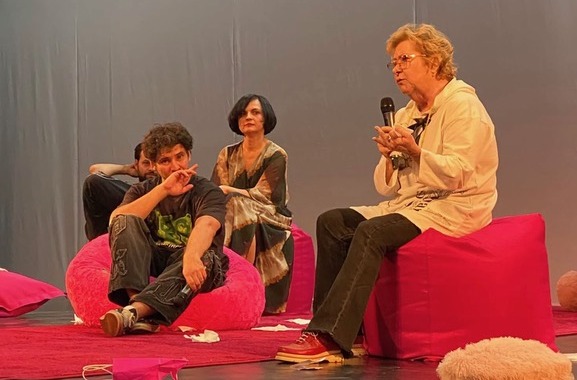
Live Theatre: Exposing the Manipulation of Human Trafficking

The following is a reduced version of comments by Costinela Caraene, producer and communication strategist with Teatrul Apropo.
The new production by Teatrul Apropo addresses human trafficking, one of the most severe forms of contemporary human exploitation. Romania remains in an extremely vulnerable position; behind the statistics lie individual destinies, real victims, manipulation tactics, exploitation networks, and – all too often – communities that either fail to see or choose to ignore what is happening right in their midst.
The title “The Romanian Epstein Case” is provocative and unsettling, alluding to a case that has become emblematic of the interplay between sexual exploitation, power, money, influence, and silence.
The aim of the production is to construct a space where the audience is compelled to look beyond the surface of the issue; to foster vigilance. It aims to make young people attentive to the language of seduction, to promises that mask traps, to the vulnerabilities exploited by traffickers, and to the community’s responsibility. The true significance of the performance lies in the question it poses to Romanian society: What mechanisms enable exploitation, and – above all – how does such a phenomenon come to be tolerated, ignored, or normalized?
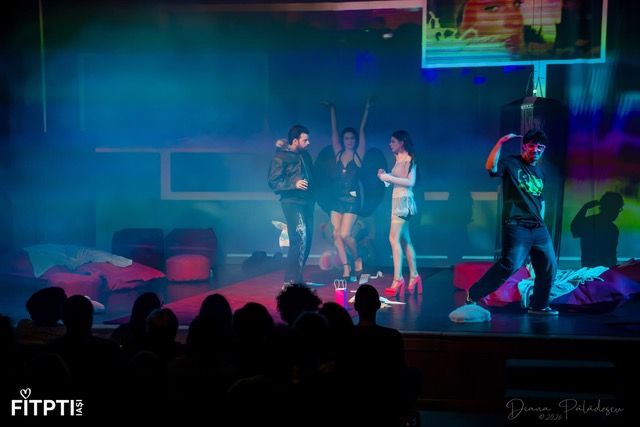
The performance also serves to engage a young audience in the educational institutions. For teenagers, discussing manipulation, vulnerability, recruitment, false promises, and exploitation can offer a chance to recognize mechanisms they might otherwise encounter without identifying them. “How do we realize something is wrong?” a teenage girl asked.
The purpose is not to solve the problem of human trafficking. However, it can break the silence, evoke empathy devoid of sentimentality, and create that moment of discomfort where the spectator realizes that what seemed distant is, in fact, much closer than they thought. “It could be someone we know at any time,” someone in the audience remarked.